Opening Hours
9 am to 7 pm Sunday 9 am to 1 pm

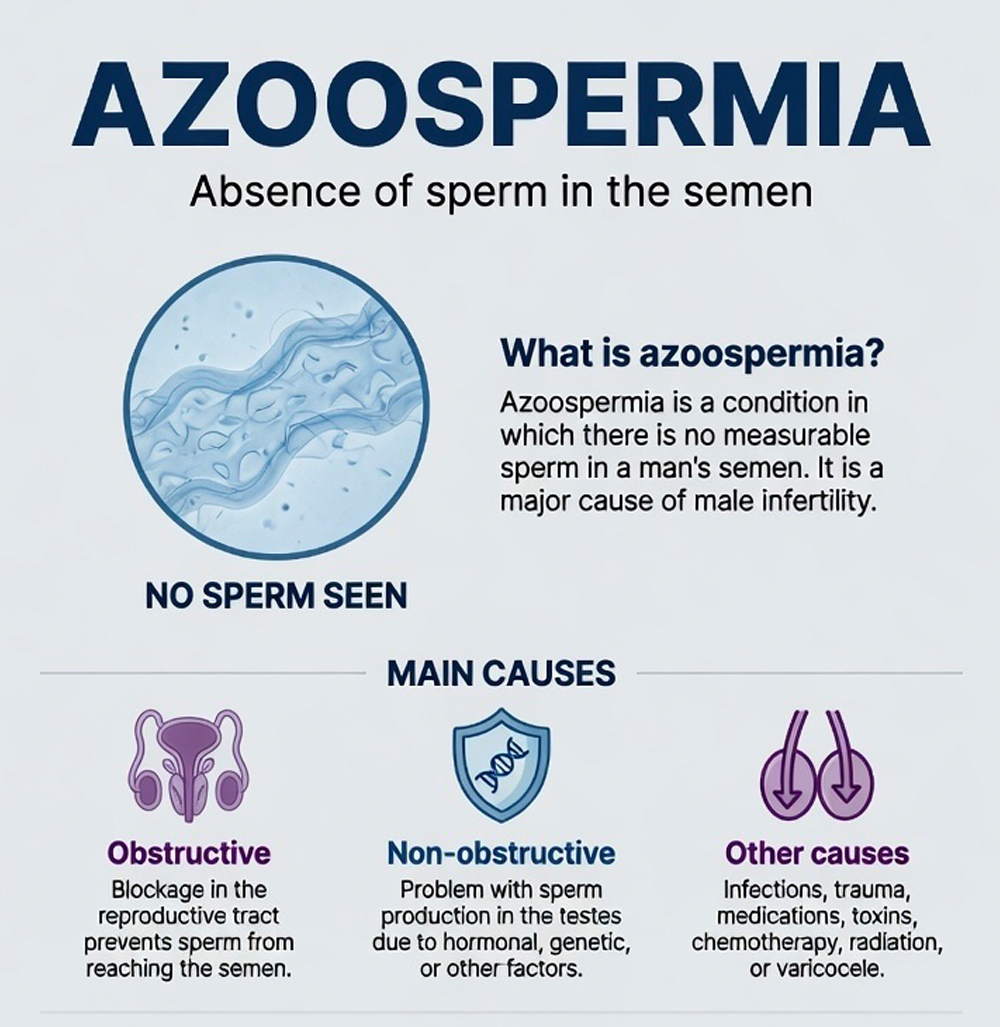
Azoospermia is a condition in which there is no sperm present in the semen (ejaculate). It is one of the significant causes of male infertility, affecting approximately 1% of all men and 10–15% of infertile men. Although men with azoospermia often have normal sexual function, the absence of sperm in the semen makes natural conception difficult. A thorough medical evaluation is essential to determine the underlying cause and identify the most appropriate treatment options.
Most men with azoospermia continue to have normal sexual desire (libido), normal erections, and normal ejaculation. However, because the semen contains no sperm, fertilization cannot occur naturally. Azoospermia is broadly classified into Obstructive Azoospermia (OA), where sperm production is normal but blocked from reaching the semen, and Non-Obstructive Azoospermia (NOA), where the testes produce very few or no sperm due to problems with sperm production.
Azoospermia is classified into two major types based on whether sperm production is normal or impaired.
In Obstructive Azoospermia (OA), the testicles produce sperm normally, but a blockage somewhere in the male reproductive tract prevents sperm from being released into the semen. Since sperm production remains normal, treatment or surgical correction may restore fertility in some cases.
Non-Obstructive Azoospermia (NOA) occurs when the testes are unable to produce sufficient sperm or fail to produce sperm altogether. It is generally caused by genetic abnormalities, hormonal disorders, or direct damage to the testicular tissue.
Many men with azoospermia experience no noticeable symptoms and discover the condition only during an infertility evaluation. When symptoms are present, they are usually related to the underlying cause, such as hormonal imbalance or testicular disorders.
Copyrights © 2026 Kovai Health Center. All Rights Reserved. Designed by  mangoe.in